


the Minister for Police and Counter-terrorism updated the House on what the Government is doing to tackle crime across the state
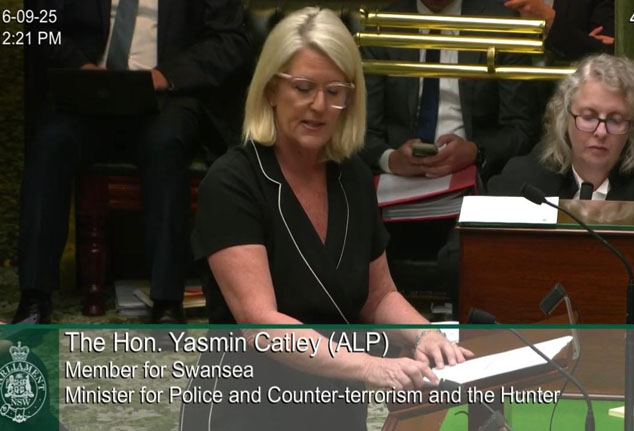
ARAB NEWS (SYDNEY -AUSTRALIA ) Can the Minister please update the House on the Government’s and New South Wales Police Force’s work to tackle crime across the state?
YASMIN CATLEY, MINISTER FOR POLICE AND COUNTER-TERRORISM:
Mr Speaker,
No statistic will ever mean as much as the level of safety people feel in their homes and on the streets, but today I want to update the House on the work NSW Police and this Government are doing to make our communities safer.
Statistics released today are showing some encouraging signs and we are rightly crediting the men and women of the NSW Police Force for the extraordinary work they are doing. They are out there around the clock tackling the worrying problem of crime in our regional communities.
This morning the Bureau of Crime Statistics and Research (BOCSAR) released its latest data.
That data shows youth crime in regional NSW has dropped by more than 12 per cent over the past two years.
In some areas, the decline is even sharper. The Far West and Orana regions – including places like Dubbo, Bourke and Broken Hill – recorded a 42 per cent drop.
Car thefts there are down by more than half, and break and enters are down by nearly two-thirds.
The New England and north-west region, which includes Moree, has also seen a 24 per cent drop.
Now, Mr Speaker, I want to be clear. Statistics are very little comfort to people who have been victims of crime, especially violent crime and especially within the sanctity of their own homes. I know this first-hand because I have met and talked to a number of them.
And perceptions matter. Many people in these communities are fearful. And that is no way to live in a country like ours. We can’t allow that to continue.
And we know there is still work to do. The Hunter Valley region has recorded an increase of 17 per cent, and across many communities the base rate of crime remains far too high.
The Deputy Mayor of Moree, Wayne Tighe, put it simply in his comments today in the Guardian.
I met Wayne just last month while spending the better part of a week in the central west, listening to those communities first-hand.
He said, and I quote: “I think a lot of it is to do with the children just obviously don’t feel safe at home …”.
That speaks volumes to the human element of these statistics. And police confirm most of these offences are committed by groups of young people out at all hours of the night.
We are not just talking about numbers. We are talking about young people, often vulnerable, often unsupported and the serious impact their actions have on the wider community.
That is why the Government and the NSWPF have been pursuing a two-pronged approach.
On one hand, police are coming down hard on repeat offenders.
Operations like Soteria have been stood up across the regions. They target the relatively small number of recidivist offenders who are responsible for the bulk of youth crime.
In just the past five months, Soteria has charged more than 200 individuals, the majority of them juveniles, with over 1,200 offences.
Turns out if you lock up the ring leaders and repeat offenders, crime drops dramatically.
On the other hand, we also have a strong focus on diversion. Through Youth Action Meetings (YAMS), police are bringing together local agencies to wrap support around at-risk young people.
More than 1,500 young people have now been referred through that system, many of them Indigenous kids, and the work of those meetings is helping to break the cycle before it hardens into a criminal career.
Youth Command officers are also working in PCYCs and schools, delivering programs like RISEUP and Pathfinder, which link young people with mentors, training and pathways to employment.
We have also strengthened the law.
Tougher bail laws for repeat offenders and new penalties for “posting and boasting” are beginning to show results.
Mr Speaker, no one on this side of the House thinks these numbers are reason for complacency. No one is saying ‘job done’, in fact this is just an invitation to work harder.
Some of the stories out of regional NSW are harrowing – families terrified in their homes, children involved in serious violent offences.
But the latest BOCSAR data shows we are moving in the right direction. It shows that the combination of enforcement, diversion and reform are beginning to make a difference.
We will not let up.
When there is crime, police will respond. And we will keep building programs that give kids a reason to choose a different path.
Because every young person we divert away from crime is a chance at life for them and a safer community for all of us.